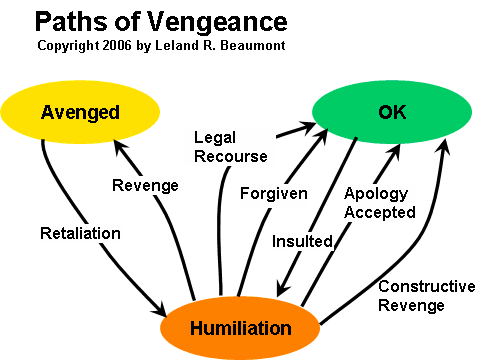
After reading this chapter, I feel that I have learned a lot about both the idea of remorse and revenge. I have come to the conclusion that seeking revenge is ultimately a waste of time if the circumstances are out of your control and unless it is attainable without much thought. In my own experience, thinking of the ways in which you can get back at someone for hurting you in some way is a pretty good way to have high stress levels and a high level of anger all the time. I find that accepting the circumstances and learning to live with the conditions you are given is a much healthier way to deal with a situation. While I would certainly like to exact revenge on a few people who have wronged me in the worst way imaginable, I refuse to attempt to get this revenge and lose myself in the process. When it comes to the idea of remorse, I have learned through my own personal experience that it is better to deal with situations in a way that you won’t be remorseful for your actions. The sense of guilt that accompanies any immoral actions is almost unbearable in my mind. I cannot do something that I will feel bitter regret for in the future because this guilt eats away at me until I have corrected the immoral situation I have created. I have found that some people have the ability to completely repress any sense of remorse for their own actions. These people are the most dangerous people in the world I have found out. One without remorse is certainly capable of doing anything with no regrets. To be able to repress any sense of remorse is a clear sign of psychological problems and probably requires immediate professional help. The emotions of revenge and remorse are definitive human qualities that I feel are very important and telling about each of us.
Monday, March 2, 2009
Journal 9: "Ghost Soldiers"
After reading this chapter, I feel that I have learned a lot about both the idea of remorse and revenge. I have come to the conclusion that seeking revenge is ultimately a waste of time if the circumstances are out of your control and unless it is attainable without much thought. In my own experience, thinking of the ways in which you can get back at someone for hurting you in some way is a pretty good way to have high stress levels and a high level of anger all the time. I find that accepting the circumstances and learning to live with the conditions you are given is a much healthier way to deal with a situation. While I would certainly like to exact revenge on a few people who have wronged me in the worst way imaginable, I refuse to attempt to get this revenge and lose myself in the process. When it comes to the idea of remorse, I have learned through my own personal experience that it is better to deal with situations in a way that you won’t be remorseful for your actions. The sense of guilt that accompanies any immoral actions is almost unbearable in my mind. I cannot do something that I will feel bitter regret for in the future because this guilt eats away at me until I have corrected the immoral situation I have created. I have found that some people have the ability to completely repress any sense of remorse for their own actions. These people are the most dangerous people in the world I have found out. One without remorse is certainly capable of doing anything with no regrets. To be able to repress any sense of remorse is a clear sign of psychological problems and probably requires immediate professional help. The emotions of revenge and remorse are definitive human qualities that I feel are very important and telling about each of us.
Journal 8: "Good Form"
Happening truth:
Last week, I visited my local Dunkin’ Donuts to buy a medium chai latte. Upon receiving this delicious drink, I took a sip of it to test how hot it was. The beverage appeared to be quite warm, but not to the point of being hot. I decide to take a big gulp of the drink, as I was cold from the freezing wind outside that I had just escaped from. Much to my dismay, the drink was indeed extremely hot and easily burned my tongue. The employees of Dunkin’ Donuts begin to chuckle and say a few condescending remarks towards me because I had not waited for the drink to cool down.
Story truth:
I stumble in, beaten down by the bitter cold and stinging winds. The setting was perfect. The shop contains vivid images of the magnificent donut. The Dunkin’ Donut. A distinguished pink frosting with an array of colored sprinkles beckons to me, tempting me to give in to my own desire of its magnificent taste and texture. As I contemplate my order, the employee grins at me. He breaks the silence. “What can I get you today, sir?” I had known all along what I would order. “One medium chai, please.” This sweet tea was always a countermeasure to the chill of the outside world. Therapeutic in nature and sweet in taste, it always gave the caffeine fix I would need to go about my routine. As I am handed my elixir, I take a small sip to get a dose of my favorite drink. The saccharine brew is all I had hoped and more. The potion is as rich as Uncle Moneybags with the intensity of the sun, leaving a content feeling similar to that of a finished Sodoku puzzle. Desperate for more of the remedy, I take a mouthful more with dizzying speed. In only an instant, my situation changes from relaxation to anguish. Alarms go off and my tongue begins to scream at me. The lava I had just ingested would take an eternity to wear off. The confusing grin of the employee changes to a loud, irritating chuckle. “Don’t you know? That drink is hot!” He laughs once more to reinforce my shame. “Why would you ever make this so hot? I want to drink it now, not in twenty minutes!” I burst through the door with Odin’s fury, hell-bent on continuing my day in the absence of the grinning menace.
Sunday, March 1, 2009
Journal 7: “Speaking of Courage” and “Notes”
When I am in the process of writing something, I have different approaches based on which type of writing it is. Whenever I am doing something creative such as poetry, I like to use rhyme as a means of explaining something. I believe that this stems from my undying love of what I consider “meaningful hip-hop.” After many years of distinguishing which hip-hop albums have the most meaning to me, my ability to tell a story in a similar type of fashion through rhyme has been refined and further developed. I find that writing in this manner is ultimately extremely rewarding and very fun to write. This type of writing style I feel has distinguished me as a writer and as a person. My joy in writing rhyme that pertains to a certain subject is a point of pride to me and helps me to think about my writing topic in a way I never would have before. I suppose this is also my favorite part of writing as well. When faced with writing about a certain subject, I find that I learn a lot more about myself and my own opinion on the subject than I would have ever done so before. My least favorite part about writing has to be the pain in my wrist that I get after writing continuously for a long period of time, such as my English midterms. Every year I have writing-only midterms for my English class and the only objection I have to these midterms is the pain in my wrist I feel after taking it. When I think back to my childhood, I remember how simplistic my sentences were, while they still conveyed a message that I can understand today. My vocabulary has been much more refined and descriptive than in my childhood, and I feel I have come a very long way in terms of the quality of my writing.
Chapter 6: Church
“‘What’s serious? I was a kid. The thing is, I believed in God and all that, but it wasn’t the religious part that interested me. Just being nice to people, that’s all. Being decent’”(O’Brien 121).
I felt a strong connection to this quote as I read this chapter, in that my own personal philosophy is quite similar to that of Henry Dobbins. While I am personally uncertain whether God exists, I find that connecting and being kind to those around me to be rewarding in its own right, even without a religious incentive to do so, such as the fear of going to Hell or wish to attain Heaven. I find that being kind for the sake of being kind is much better than being kind for the sake of being judged by a higher being in an afterlife. Dobbins’ interaction with the two monks reminded me of the way people usually treat each other when I work at Trader Joes. While my fellow employees are instructed to be kind and helpful to our customers, I often find my co-workers going out of their way to help someone with whatever they need help with. This shows me that they have a similar mentality to mine in that they understand that we are all in this life together, and to help one another is the best way to go about life. To respect one another despite all our personal differences is an essential human quality to me and Dobbins’ interaction with the two monks reminded me of that fact.
Journal 5: “The Sweetheart of Song Tra Bong”
After reading of Mary Anne Bell’s transformation in behavior, it became clear to me that this story is more than likely made up. The notion that a normal person could actually go to the point of wearing human tongues around her neck after being in Vietnam for a little while is completely ridiculous in my mind. Obviously Mary Anne must have had some deep emotional problems to undergo such a rapid transformation after seeing a few dead bodies. This image is so powerful that it seems clear to me that O’Brien must have been trying to send a message in her story. Perhaps O’Brien is trying to show how traumatic events such as tending to the casualties of a war could have a serious effect on that person. I know this idea better than most, which is why I can understand how O’Brien could have thought that the reader would buy into this idea. However, it seems quite transparent when I think deeply about the change in Mary Anne’s behavior. I think it is clear that O’Brien portrays Mary Anne as definitely going insane. A person faced with a new culture that adapts to it so quickly and devoutly must have had serious problems before even arriving in Vietnam.
Journal 4: “How to Tell a True War Story”
O’Brien explains that sometimes a true war story cannot be believed because the worst parts are absolutely true, but the normal parts of the story are not. He also explains that sometimes a true war story is impossible to tell. This influences the events of the rest of the book in that O’Brien himself is trying to tell a war story. It affects the reader’s perception of what actually happened and what O’Brien could have possibly made up or exaggerated, as well as those stories that are impossible to tell. It serves as a disconnection between the reader and the soldiers that were actually there. Since none of the readers actually witnessed anything that happened in O’Brien’s tale, it is unknowable whether it truly happened the way O’Brien tells it. O’Brien also notes that the significance of a true war story is whether you believe it in your stomach, and that a true war story can be identified by the questions one has after reading one. In this regard, O’Brien basically tells us that the truth of a true war story is whether you can identify with the person who lived or wrote it. O’Brien tries, even through something that could have been made up, to have the reader feel the same way he did when he was living through the war. The feeling you get in your stomach, he argues, is what is really important, even if the story isn’t true. The impact on the reader who reads the story is what is really important when you cannot tell if the story is absolutely true, regardless of the facts of the story. The death of the baby water buffalo was certainly more disturbing than the death of Curt Lemon because of the way O’Brien tells it. Instead of portraying the death of Curt Lemon as a violent death, he pays more attention to the sunlight and the beauty of what happened instead of the ugliness. I’m sure that if O’Brien described his death as a more violent and grotesque one, the death of the baby water buffalo would have had much less of an impact on me, the reader. This shows that O’Brien has control over the events of his story, as he can make what happened into any manner he pleases. O’Brien also notes that his story is a love story, not a war story. He says this due to the fact that soldiers like himself who tell war stories hyperbolize these tales because they love enthralling outside audiences to the way their lives were during the war in which they fought in. The idea of war enraptures their minds so much that they feel that inserting a few fallacies can become as real to them and outside audiences as if it had actually happened.
Journal 3: "On The Rainy River"
O’Brien calls himself a coward for going to war because he did not go to Vietnam to be brave or because he felt it was his patriotic duty as an American to do so. The reason he went to war was because he couldn’t bear the shame of not going to war. O’Brien wishes to flee to Canada to dodge the draft, but the shame of this action would be gossiped about by his community and family, which he could not bear. The only reason he decides to go to Vietnam is because he is too embarrassed not to go. Thus, he considers himself a coward. I believe he was quite cowardly for going to war. O’Brien considered the war to go against his own principles, so by deciding to still go and fight in Vietnam is quite cowardly. If I were placed in a similar situation, I would probably have fled to Canada anyway. Bearing the shame of not going to war is a small price to pay if it means keeping your principles over that shame. It wouldn’t matter to me that much if someone hundreds of miles away was gossiping about how I dodged a draft if it meant that I truly upheld my own beliefs and my own personal judgment of an unjust war.
I feel that a draft of any kind in the war in Iraq is unjust. In my personal opinion, the war in Iraq is an unnecessary war, which has cost America dearly, both financially and through the unfortunate deaths of our own soldiers as well as Iraqi civilians. By forcing those in the military to continue their duty after their time is up, it shows that the government is handling this war in an unfair and unjust manner. I am sure that there are many of those in the military who are now against this war and just want to go home. It is unthinkable to force them to stay out there against their will, against the amount of time that they signed up to serve. I personally believe that the war in Iraq is the new Vietnam. It is clear that this war is unnecessary, just as the war in Vietnam was. If I were put in O’Brien’s shoes, I would probably flee to Canada to dodge the war in Iraq. I would do this not because I am not patriotic, but because this war is clearly unnecessary and it goes against my own principles. I would, however, serve in the military if I felt a war was necessary and being conducted for the right reasons, like the U.S. involvement in World War II was.
Journal 2: “Love” and “Spin”
As I woke to an ordinary summer day, I was unaware that this would be a definitive moment in my life. I went through the morning motions, shower, breakfast, the ordinary and common events that I was so accustomed to. My sister then approached me and informed me that something was going on between my mother and my father. They had their fair share of problems, but little did I know that this extraordinary day would change my family forever. As I walked downstairs, I could hear the faint sound of an argument, nothing new in my household. It seemed as if the further I walked down those stairs, the worse their arguments got. Finally all the way to the bottom of the stairs, I could decipher exactly what was going on in the other side of the house. My father was leaving. Not leaving for work or to clear his mind, but leaving for good. With no explanation and several bags of clothing, he walked out that door. The shock of this event is an emotion I would never forget. However, there were many emotions felt by my remaining family, mostly confusion, anger, and sadness. I will never forget my mother’s reaction to this event, talking on the phone with my grandmother, crying because she had no idea what to do. I recall that she asked several questions that made me truly realize the importance of what had just occurred. Not only did my dad leave us, which would have been a lot to bear in itself, but now our family had no way to make money or pay the mortgage on our house. I think that my memory of her hysterical crying over everything that had happened is something I will never forget. I was so upset by what happened that I took two days off from work to get my head straight and figure out what was going to happen. While there are several other memories related to my father (after this occurrence), I will always remember this one in that it was the day my father checked out of my family for good. I will never forget this event because it started all the pain and struggle that my family has gone through even up to this very day.
Subscribe to:
Comments (Atom)